
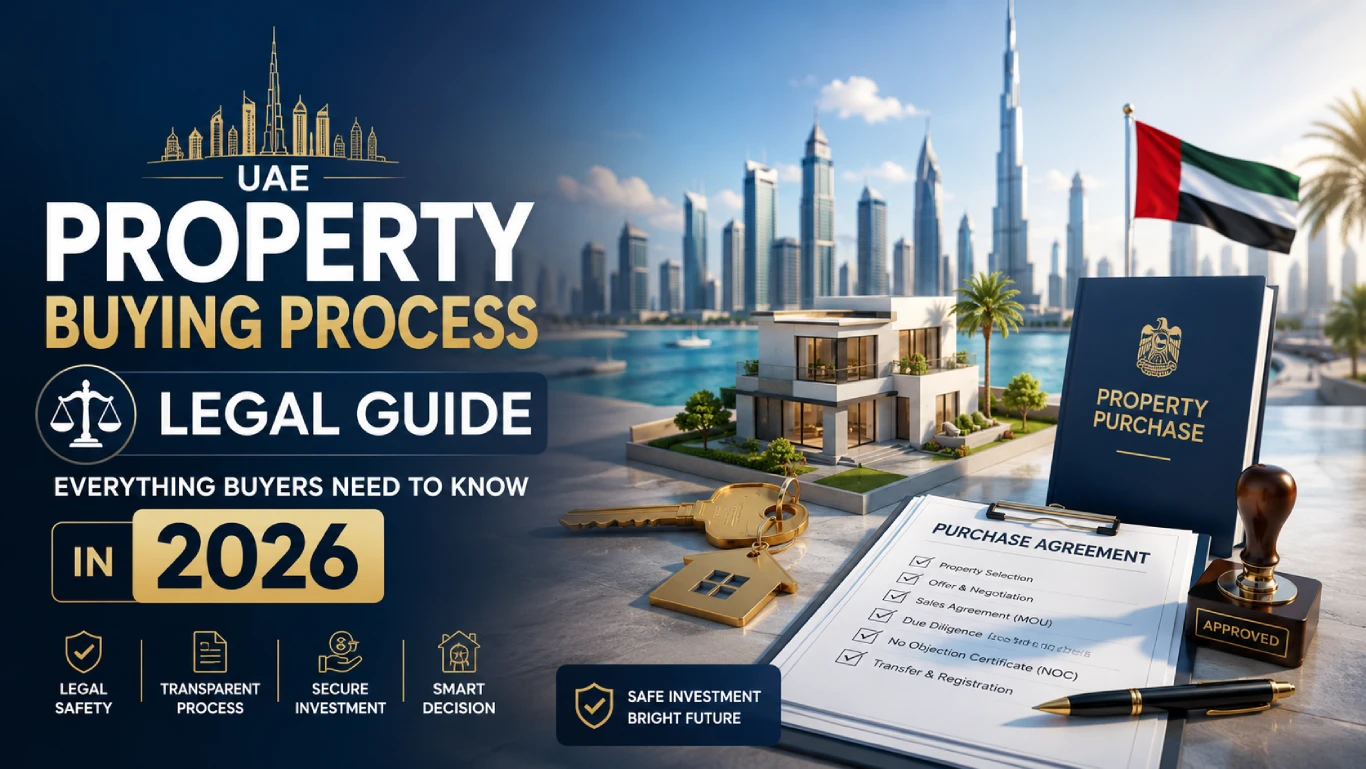
UAE Property Buying Process Legal Guide Everything Buyers Need to Know in 2026
Purchasing a property in the UAE may be a thrilling experience at first, but it can get quite confusing when the paperwork starts to pile up.
At first, you might be picturing rental income, residency perks, and the potential increase in property value over time. However, soon you find yourself struggling hard to understand the title deeds, property transfer fees, escrow arrangements, legal paperwork, etc.
Besides picking a wrong property, the other major reason why many buyers end up losing their money is misinterpreting the legal requirements of the UAE property buying process.
What’s the silver lining?
The UAE market is considered to have one of the most transparent and investor-friendly real estate systems in the world. In fact, after you get a hold of the legal framework, property purchase transaction can be much easier and safer.
This exhaustive guide will take you through each and every legal procedure involved in buying a property in the UAE, whether you are a beginner, foreign investor, working resident, or developer.
Why Understanding UAE Property Laws Matters
Buying or selling a property is a major financial decision.
Mistakes in legal examination can lead to :
- The buyer and seller not agreeing on the property ownership
- Property transfer being held up for a very long time
- Being stuck with debts and problems the current owner had not disclosed
- Issues related to the contract agreement
- Payment of fines or penalties
- Difficulties in obtaining a mortgage
Knowing where you stand legally empowers you to :
✅ Safeguard your investment
✅ Prevent expensive errors
✅ Have a hassle-free completion
✅ Comply with the law
✅ Be confident about your property ownership
Can Foreigners Legally Buy Property in the UAE?
International investors often seriously contemplate the following question :
“Is it possible for foreigners to invest in real estate in the UAE?“
We’re happy to inform you that the answer is in the affirmative.
Foreigners do have the opportunity to buy freehold properties in specific regions earmarked for investment throughout the UAE by locating the right areas.
Well-known neighborhoods offering freehold ownership rights include :
| Emirate | Popular Freehold Areas |
| Dubai | Dubai Marina, Downtown Dubai, Business Bay, Palm Jumeirah, JVC |
| Abu Dhabi | Yas Island, Saadiyat Island, Al Reem Island |
| Ras Al Khaimah | Al Marjan Island |
| Sharjah | Selected designated investment zones |
When purchasing in a freehold area, buyers receive full ownership rights and can sell, lease, or transfer the property.
Understanding the UAE Property Buying Process Legal Framework
The UAE real estate market is governed by a set of tight rules that aim to secure the interests of both the buyer and the seller.
Main regulatory bodies :
- Dubai Land Department (DLD)
- Real Estate Regulatory Agency (RERA)
- Abu Dhabi Real Estate Centre (ADREC)
- Municipality Land Departments
- Registered Trustee Offices
Their areas of control :
- Recording properties
- Selling and buying ownership among people
- Regulating escrow accounts
- Granting licenses to brokers
- Ensuring rules are being followed
Step 1: Verify Property Eligibility and Ownership
Do thorough due diligence prior to signing anything.
What should the buyers look for? Ownership Verification
Confirm :
- Seller is the lawful owner.
- Ownership rights are not contested with other people.
- Title deed is authentic
- There are no unauthorized claims.
- Outstanding Liabilities
Review :
- Service charge arrears
- Mortgage obligations
- Utility dues
- Developer-related charges
- Property Status
Check :
- Freehold eligibility
- Completion status
- Legal permits
- Community regulations
Always ask for a copy of the title deed prior to any investment.
Step 2 : Obtain Mortgage Pre-Approval (If Applicable)
If you plan on financing your purchase, it is advisable that obtaining mortgage pre-approval becomes your first step.
Usually, most banks in UAE look at the following aspects for mortgage pre-approval :
- Whether your income is stable or not
- Credit history check
- Employment details
- Existing debts/liabilities
- Price of the property
Typically, you will be required to present documents such as :
- Copy of your passport
- Emirates ID
- Copy of your Visa
- Salary certificate
- Recent bank statements
Obtaining pre-approval not only gives you more leverage in negotiations but also facilitates the transaction process.
Step 3 : Sign the Memorandum of Understanding (MOU)
When the price for the property has been decided, a Memorandum of Understanding is signed by both sides.
In Dubai, people usually call it :
Form F
The main points mentioned in the MOU are :
- Price of the property
- Payment schedule
- Who will be doing what and when
- Rights and obligations of both parties
- Consequences of breach of contract
Usually, buyers pay a down payment of about 10% at this stage.
You should : Thoroughly check every clause before signing.
Step 4 : Conduct Legal Due Diligence
It is during this part of the process that most successful investors distinguish themselves from inexperienced buyers.
Most Important Legal Checks
Who owns the property?
Make sure that the seller is actually the owner of the property in question.
Is there a mortgage on the property?
Work out if :
- Existing financing is still in place
- The mortgaging bank must be repaid before ownership is transferred
What if it is a secondary sale?
You should :
- Make certain the developer has not levied any new service charges
- Get copies of any No Objection Certificates (NOC)
How to verify an off-plan property?
If you want to buy an off-plan property, it would be best to :
- Check developer registration
- Find out the escrow account status
- Construction approvals
- Completion timelines
Step 5 : Obtain a No Objection Certificate (NOC)
The developer issues a No Objection Certificate certifying that :
- There are no pending service charges.
- Seller has fulfilled all the obligations.
- Approval for owner transfer.
Ownership transfer is typically not allowed without an NOC from the developer.
Developers have different turnaround times for processing, but most often it takes from a few days to a few weeks.
Step 6 : Property Transfer at the Land Department
This is the key legal phase.
Buyer and seller will be present at :
- Dubai Land Department Trustee Office
- Land Registration Authority at the location
Normally, documents for submission include :
- Passport
- Emirates ID
- Title deed
- NOC
- Manager’s cheque
- Mortgage if any
At the time of transfer :
- Payment confirmation
- Transfer of ownership
- Deposit of registration fees
- Generation of new title deed
Step 7 : Receive the New Title Deed
Upon the completion of the registration process, the buyer is given the title deed.
This document is the only authentic ownership proof certification.
It comprises the following information :
- Identity of the owner
- Property description
- Plot details
- Registration information
Have both the physical and digital versions of the document kept in a safe place.
Typical Costs Associated with Property Purchase
Understanding transaction costs helps avoid budget surprises.
| Cost Type | Typical Amount |
| DLD Registration Fee | 4% of property value |
| Trustee Fee | Varies by property value |
| Broker Commission | Usually 2% |
| NOC Fee | Developer dependent |
| Mortgage Registration Fee | Applicable if financed |
| Administrative Charges | Variable |
Always request a complete cost breakdown before proceeding.
Buying Off-Plan Property : Additional Legal Considerations
Off-plan properties have a lot of appeal not only in Dubai but also all over the UAE.
But besides that, more legal verifications are required.
Check Escrow Account Security
Developers need to have escrow accounts under strict regulations.
Through this, the buying party’s money is not only safe but is solely utilized for the building of the project that is being developed.
Examine the SPA Thoroughly
The Sales and Purchase Agreement must be very comprehensive so as to cover the following :
- Installment plans
- Estimation of finish
- Penalty of delay
- Termination of contract
- Ownership transfer
It is a mistake to count on word of mouth only.
Common Legal Mistakes Buyers Should Avoid
Skipping Due Diligence
Many buyers trust marketing materials without verifying legal details.
Ignoring Service Charge History
Outstanding fees can create future complications.
Not Reviewing Contracts
Always understand every contractual obligation.
Using Unlicensed Brokers
Work only with RERA-registered professionals.
Failing to Verify Ownership
Title deed verification is essential.
Do You Need a Lawyer to Buy Property in the UAE?
Legally, it’s not compulsory to get a lawyer. But legal help can come in handy especially when dealing with :
- Transactions involving large amounts of money
- Business investments
- Purchases of properties that have not yet been built
- Foreign buyers
- Complicated property ownership structures
Having a property attorney on your side can help you go through the paperwork, point out any possible issues, and make sure that everything is done according to the law.
Frequently Asked Questions
How long does the property transfer process take in Dubai?
Usually, simple transactions may only take a few days after all the required documents are ready.
Can non-residents buy property in Dubai?
Certainly. Overseas investors are allowed to buy properties only in specific freehold areas.
What is the most important legal document?
The title deed is the main evidence of ownership.
Is off-plan property safe?
If the project has been approved and registered, and the developer’s funds are protected via regulated escrow account, then yes.
What happens after ownership transfer?
Upon ownership transfer, legally, the buyer is recognized as the owner and is allowed to live in the property, rent it out or even resell it in accordance with UAE laws.
Final Thoughts
The legal framework of the UAE property buying process aims to not only safeguard the investors but also to keep the market very transparent.
Each step from validating the owner, approving a mortgage, recording the title deed, to finalizing the transfer contributes significantly to the security of your investment.
Buyers who conduct thorough research, collaborate with licensed professionals, and are acquainted with the legal process remarkably decrease risks and at the same time enhance their investment capabilities.
If you are buying an apartment for the first time in Dubai Marina, investing into an off-plan property, or growing your real estate portfolio, knowing the legal procedure is an essential step to accomplish a successful transaction.
Want to Invest in UAE Real Estate?
Collaborate with real estate experts who have extensive knowledge of UAE property laws, compliance issues, and investment scope.
When you get a professional helping hand, you will be able to legally buy your property without any problems and thus get the one that perfectly suits your investment purposes in the UAE.
Property investment in Dubai is undoubtedly a great way to your invest in a global asset that offers strong returns. The presence of well-regulated laws, outstanding tax benefits, and a steadily rising population, make the 2026 market a great place to park your money with an excellent return.
The property types range from a lavish villa in Dubai Hills to a highly profitable off-plan apartment in JVC. Dar Al Naseem Real Estate staff are on hand to support you in making the right decision. Simply arrange a consultation with our professionals here on our Contact Us page.
Ready to invest in Dubai Real Estate?
Connect with our senior consultants today for personalized advice and exclusive property listings.
Whats App : +971 50 883 4245 Email : mdkhaleel@daralnaseemdxb.com

Recent Posts

JVC Apartment for Sale – Top 5 Reasons to Buy in 2026